

Measuring packaging distortion during an autoclave heat treatment cycle
Autoclave heat treatment is a critical step in the food and pharmaceutical industries to ensure product sterility. While controlling thermal parameters (temperature, time, F0 value) is essential for microbiological safety, managing the mechanical stresses applied to packaging is equally critical.
During a pasteurisation or sterilisation cycle, packaging undergoes significant temperature and pressure variations that can cause distortion or even seal failure. Measuring and analysing these deformations is therefore essential for optimising cycles, reducing losses and securing container integrity.
Origins of packaging distortion in the autoclave
Under the combined effect of temperature and pressure, packaging can deform. During heat treatment, packaging is subjected to:
- A rise in internal pressure (expansion of the product and residual gases),
- External pressure from the autoclave operation,
- Thermal gradients between the product, the headspace and the container wall.
An imbalance between internal and external pressure can lead to:
- Lid bulging,
- Sidewall deformation (for example in plastic trays),
- Seal failure.
A thorough understanding of these phenomena requires appropriate measurement tools.
Why measure deformation?
Deformation measurement makes it possible to:
- Validate the robustness of a new packaging format,
- Optimise counter-pressure profiles,
- Reduce defects (leaks, weakened seals, visible deformation),
- Improve looking product quality,
- Lower costs associated with excessive overpressure (compressed air consumption).
The goal is therefore to achieve the optimal balance between internal and external pressure.
Deformation measurement method: the displacement probe
Using a pressure sensor placed inside the packaging allows internal and external pressures to be compared and critical discrepancies to be identified. However, this approach is only suited to rigid packaging (cans, jars).
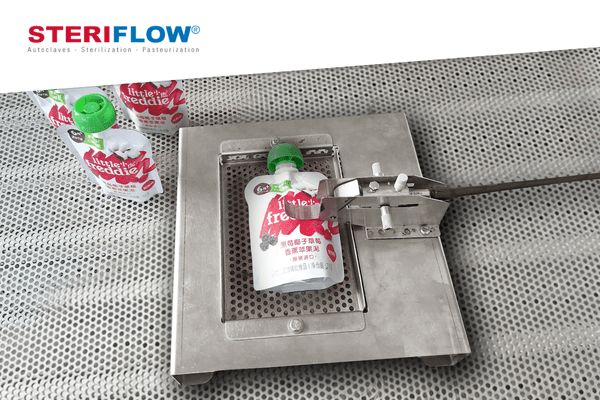
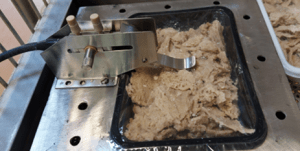
To measure distortion in real time on flexible or semi-rigid packaging (e.g. trays), a deflection sensor is the preferred solution. This sensor measures the physical displacement, in millimetres, of the specific area of the packaging on which it is positioned, for example:
- Lid deflection
- Volume change in a film-sealed tray,
- Expansion or contraction of a pouch.
Conclusion
Measuring packaging deformation during an autoclave heat treatment cycle is an essential tool for moving from empirical adjustment to precise control of the temperature and pressure stresses experienced by the packaging. Through real-time measurement technologies applied to flexible and semi-rigid packaging, it becomes possible to:
- Accurately identify critical phases,
- Optimise back-pressure profiles,
- Secure packaging integrity,
- And improve the overall process performance.
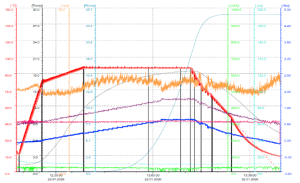
Orange > deflexion
Steriflow supports you in optimising your counter-pressure profiles and diagnosing your current cycles. Our test laboratory is equipped with pilot autoclaves where your cycles can be reproduced and analysed. Using internal pressure probe and a deflection sensor, our team can correct and optimise your processing schedules.