

Hydraulic test of industrial autoclaves: what pressure testing actually reveals
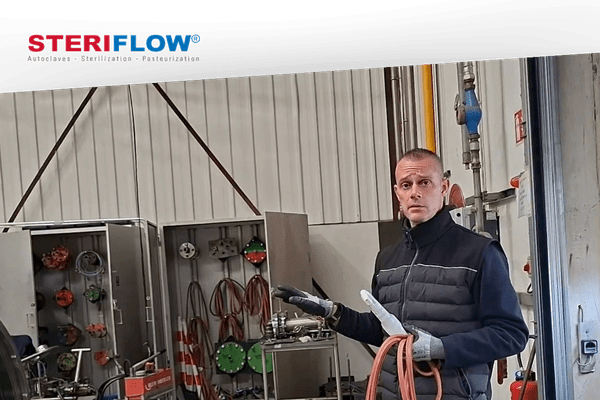
Hydraulic test is not merely a regulatory formality. When properly conducted, it serves as a precise diagnostic tool for assessing the structural integrity of an autoclave prior to commissioning. At Steriflow, and unlike certain autoclave manufacturers, we are committed to preserving our in-house boilermaking expertise. As a result, all hydraulic tests are performed internally at our facility. The following is an account of the critical steps in this procedure as they unfold on the shop floor.
Preparation: a stage that already determines the outcome
Before pressure is even applied, the quality of the test depends largely on the care taken during equipment preparation. The complete plugging of all orifices and the fitting of flanges must ensure unambiguous sealing: any leak at this stage compromises the accuracy of readings during the test phase. Particular attention must be paid to the installation of the door gasket. A gasket with even the slightest fold in its groove introduces a localized weak point.
This type of defect, invisible prior to pressurization, is precisely what the hydraulic test is designed to detect. The door is then installed in its final configuration, adjusted specifically to each unit and not interchangeable between machines.
Filling and purging: distinguishing between leaks and air purging
Filling is carried out using the main water supply at an inlet pressure of approximately 3.5 bars. This phase inevitably produces surface water flow, caused by the purging of air trapped in the circuit. This is a normal occurrence and ceases once the autoclave is fully filled and the door is held firmly in place by internal pressure. Only the condition of the equipment once the test pressure has been reached and stabilized is considered determinative.
8.6 bar, 30 to 45 minutes: what pressure hold performance indicates
Test pressure is maintained for between thirty minutes and three quarters of an hour. This is not an arbitrary duration: it allows sufficient time for stresses to redistribute within the material and for any defects to manifest, including those that are slow to appear. A unit that shows no visible signs of failure in the first few minutes but exhibits seepage toward the end of the hold period does not pass the test.
The visual inspection conducted throughout this window covers the entire surface of the equipment: welds, flanges, covers, and areas beneath the machine. No zone is presumed sound without direct verification. One important distinction to note: the final visual inspection, carried out immediately before draining, is separate from the continuous monitoring performed during pressurization. It is the final inspection that determines definitive test validation. Both are required.
Draining and sign-off: a sequence that cannot be reversed
The test is only declared compliant upon completion of the final visual inspection, prior to draining. This order is not incidental: depressurization mechanically alters the condition of gaskets and assemblies. Validating after draining would mean inspecting a state that no longer reflects the conditions under which the equipment will actually operate.